
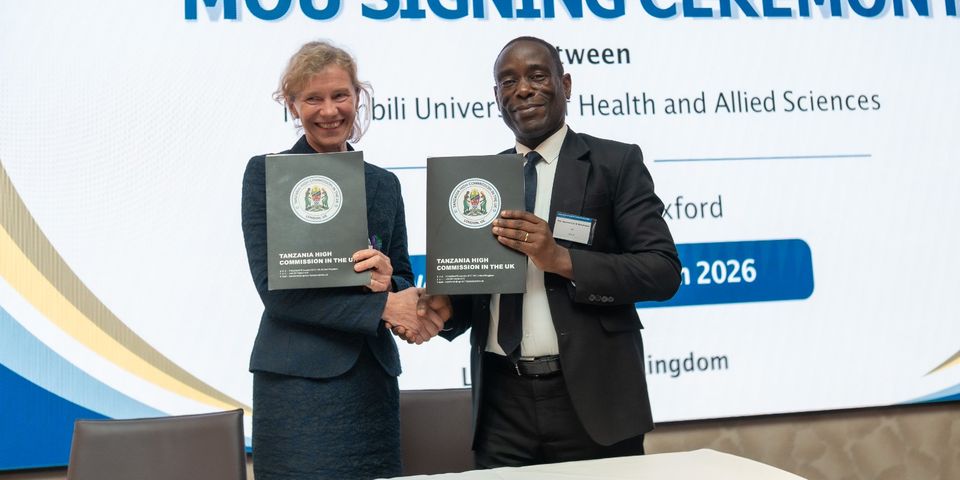
Dar es Salaam: Tanzania, is intensifying its response to a rapidly growing cancer burden through a strategic partnership between Muhimbili University of Health and Allied Sciences (MUHAS) and the University of Oxford. The agreement places cancer care, research and innovation at the centre of collaboration, signalling a shift toward more advanced, data-driven healthcare solutions.
Cancer has emerged as a major public health challenge in Tanzania, with GLOBOCAN 2022 estimates indicating between 40,000 and 45,000 new cases annually and nearly 30,000 deaths. Experts attribute the high mortality rate largely to late diagnosis, limited screening services and a shortage of specialised oncology professionals, leaving many patients with constrained treatment options.
The MUHAS–Oxford memorandum of understanding aims to directly address these gaps. The partnership will focus on clinical training and mentorship in oncology, strengthening research capacity, and integrating data science and artificial intelligence into cancer diagnosis. Anchored under the Oxford Global Cancer Initiative, the collaboration also seeks to produce policy-relevant research aligned with Tanzania’s National Cancer Strategy.
MUHAS Vice Chancellor Prof Appolinary Kamuhabwa said the agreement marks a transition toward solution-oriented academic leadership. He noted that global partnerships are critical in expanding research capability, enhancing training and driving innovation that directly benefits communities. Health experts add that collaboration with a globally recognised institution like Oxford accelerates access to clinical trials, data systems and international research networks.
The partnership is also expected to significantly improve skills transfer through exchange programmes, equipping Tanzanian doctors and researchers with specialised oncology expertise. With more than 90 per cent of cancer cases currently diagnosed at advanced stages, improved early detection and exposure to global best practices could transform patient outcomes across the country.
This initiative aligns with broader national efforts to curb cancer-related deaths. The government has committed to reducing mortality by at least 30 per cent while investing in diagnostic infrastructure, including Sh18.5 billion for PET-CT scan and Cyclotron services at Ocean Road Cancer Institute. As non-communicable diseases rise alongside infectious illnesses, Tanzania’s push for global collaboration reflects a strategic pivot toward sustainable, research-driven healthcare.