
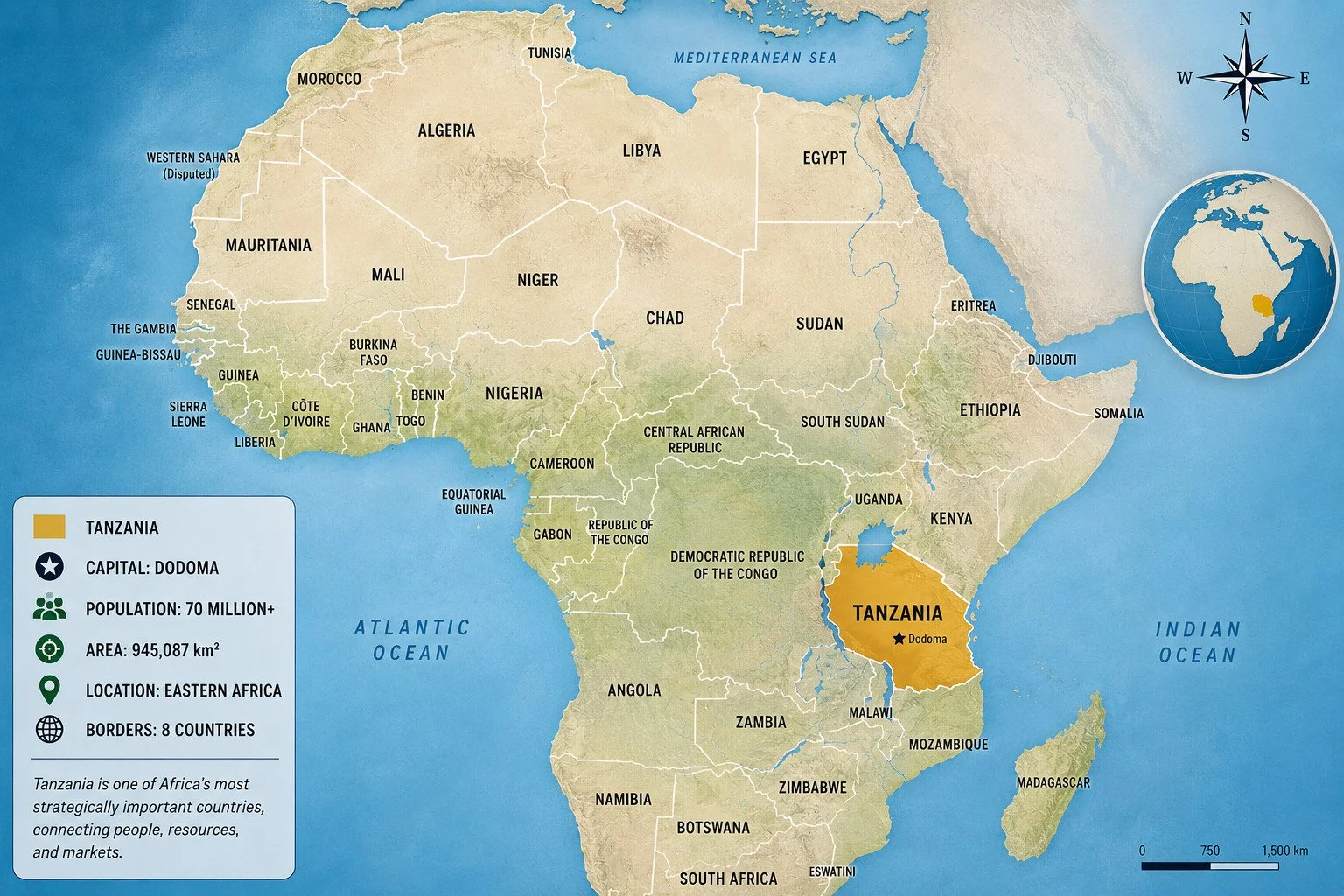
From rare earth minerals and critical battery metals to strategic ports, tourism assets, and one of Africa’s fastest growing consumer markets, Tanzania possesses advantages that few countries can match. These 30 facts reveal the economic forces shaping one of the continent’s most underrated strategic economies.
Most conversations about Tanzania focus on wildlife, Mount Kilimanjaro, or Zanzibar’s beaches. Those stories are real, but they reveal only a fraction of the country’s significance.
Beneath Tanzania’s soil lie some of the world’s most strategic minerals. Across its territory sit trade corridors that connect six landlocked countries to global markets. Its coastline opens onto one of the busiest maritime regions on Earth. Its agricultural lands feed millions. Its tourism assets generate billions. Its population is creating one of Africa’s fastest growing consumer markets.
Tanzania is often discussed as a developing economy. It is more accurately understood as a country whose strategic value is still being discovered.
These 30 facts reveal Tanzania through an economic lens. They show a nation whose importance extends far beyond its borders and whose future influence may be far larger than current perceptions suggest.
30. Tanzania sits on one of Africa’s largest geological endowments.
The country contains commercially significant deposits of gold, diamonds, tanzanite, graphite, nickel, coal, iron ore, rare earth elements, helium, natural gas, and critical battery minerals. Few countries possess such mineral diversity within a single territory.
29. Tanzania is the only country on Earth that produces Tanzanite.
Tanzanite is mined exclusively in Merelani near Arusha. When the deposit is exhausted, no new supply will emerge elsewhere unless an entirely unknown geological occurrence is discovered.
28. Tanzania possesses one of the world’s largest rare earth deposits.
The Ngualla project in the Southern Highlands contains hundreds of millions of tonnes of rare earth resources. These minerals are essential for electric vehicles, wind turbines, smartphones, and advanced defense technologies.
27. Tanzania holds strategic graphite reserves.
Graphite is a core component of lithium ion batteries. Tanzania’s deposits have attracted global attention as manufacturers seek alternatives to concentrated supply chains elsewhere.
26. The country is among Africa’s leading gold producers.
Gold remains one of Tanzania’s largest export earners and a major source of foreign exchange.
25. Tanzania’s natural gas reserves exceed 57 trillion cubic feet.
Large offshore discoveries have positioned the country as a future regional energy supplier and potential LNG exporter.
24. Tanzania has one of the world’s largest undeveloped nickel resources.
Nickel is critical for high performance batteries and electric mobility. Global demand is expected to rise significantly over the coming decades.
23. Iron ore deposits in Liganga could support a domestic steel industry.
The resource base is large enough to underpin industrialization if linked with power generation, transport infrastructure, and manufacturing.
22. Tanzania exports a mineral found inside billions of electronic devices.
Coltan, which contains tantalum, is used in capacitors found in smartphones, laptops, and other electronics.
21. The country may hold some of the world’s most significant helium reserves.
Helium is essential for MRI scanners, semiconductor manufacturing, aerospace applications, and scientific research. Global supplies are limited.
20. Tanzania controls access to six landlocked countries.
Its ports serve trade flows for Zambia, Malawi, Burundi, Rwanda, Uganda, and the eastern regions of Democratic Republic of the Congo.
19. Dar es Salaam is one of Africa’s fastest growing commercial cities.
Dar es Salaam functions as a major logistics, finance, trade, and services hub for East and Central Africa.
18. Tanzania operates Africa’s largest protected wildlife estate.
The combined protected areas network supports a tourism industry that generates billions of dollars annually and sustains hundreds of thousands of jobs.
17. Tourism is one of Tanzania’s largest export sectors.
Unlike traditional exports, tourism brings foreign currency directly into local hotels, transport providers, restaurants, guides, and communities.
16. The Serengeti is not just a conservation asset. It is an economic asset.
Serengeti National Park attracts visitors from around the world and remains one of the strongest tourism brands on the African continent.
15. Zanzibar produces some of the world’s most valuable cloves.
Zanzibar has been a major spice producer for centuries and remains one of the world’s leading clove growing regions.
14. Tanzania has more than 1,400 kilometers of Indian Ocean coastline.
This provides opportunities in shipping, fisheries, tourism, offshore energy, and maritime trade.
13. The Port of Dar es Salaam serves a market far larger than Tanzania itself.
Its economic influence extends deep into East and Central Africa, making it one of the region’s most strategically important trade gateways.
12. Tanzania’s population has surpassed 65 million people.
That creates one of Africa’s largest and fastest growing domestic consumer markets.
11. The country is among Africa’s largest agricultural producers.
Agriculture employs the majority of Tanzanians and contributes significantly to exports and food security.
10. Tanzania is one of the world’s largest cashew producers.
Cashews are a major foreign exchange earner and support millions of livelihoods across coastal and southern regions.
9. Coffee remains one of Tanzania’s global brands.
Tanzanian coffee is exported to premium markets across Europe, Asia, and North America.
8. Tanzania’s electricity generation capacity has expanded rapidly.
Large investments in hydropower, natural gas, and transmission infrastructure are reshaping the country’s industrial potential.
7. The Standard Gauge Railway is changing regional trade economics.
The railway reduces transport costs and strengthens Tanzania’s position as a logistics hub connecting inland Africa to the ocean.
6. Tanzania hosts Africa’s largest freshwater lake by surface area.
Lake Victoria supports fisheries, transport, agriculture, and regional commerce across multiple countries.
5. Lake Tanganyika contains roughly 17 percent of the world’s liquid freshwater.
Lake Tanganyika is not only a natural wonder. It is a strategic freshwater resource.
4. Tanzania has one of Africa’s most diversified economies.
Growth is spread across agriculture, mining, tourism, manufacturing, logistics, construction, telecommunications, and financial services.
3. The country is becoming a major player in the global energy transition.
Graphite, nickel, rare earths, helium, natural gas, and renewable energy potential place Tanzania at the center of several future supply chains.
2. Tanzania’s location is its greatest economic advantage.
It sits at the intersection of Southern Africa, East Africa, the Indian Ocean, and the Great Lakes region. Geography gives it access to markets that collectively contain hundreds of millions of people.
1. Tanzania may be one of the most undervalued strategic economies in the world.
It combines critical minerals, agricultural capacity, tourism assets, energy resources, demographic growth, political stability, and access to the sea. Very few countries possess all of them at the same time.
Most countries have one economic story. Tanzania has at least five, and most of them are still being written.