
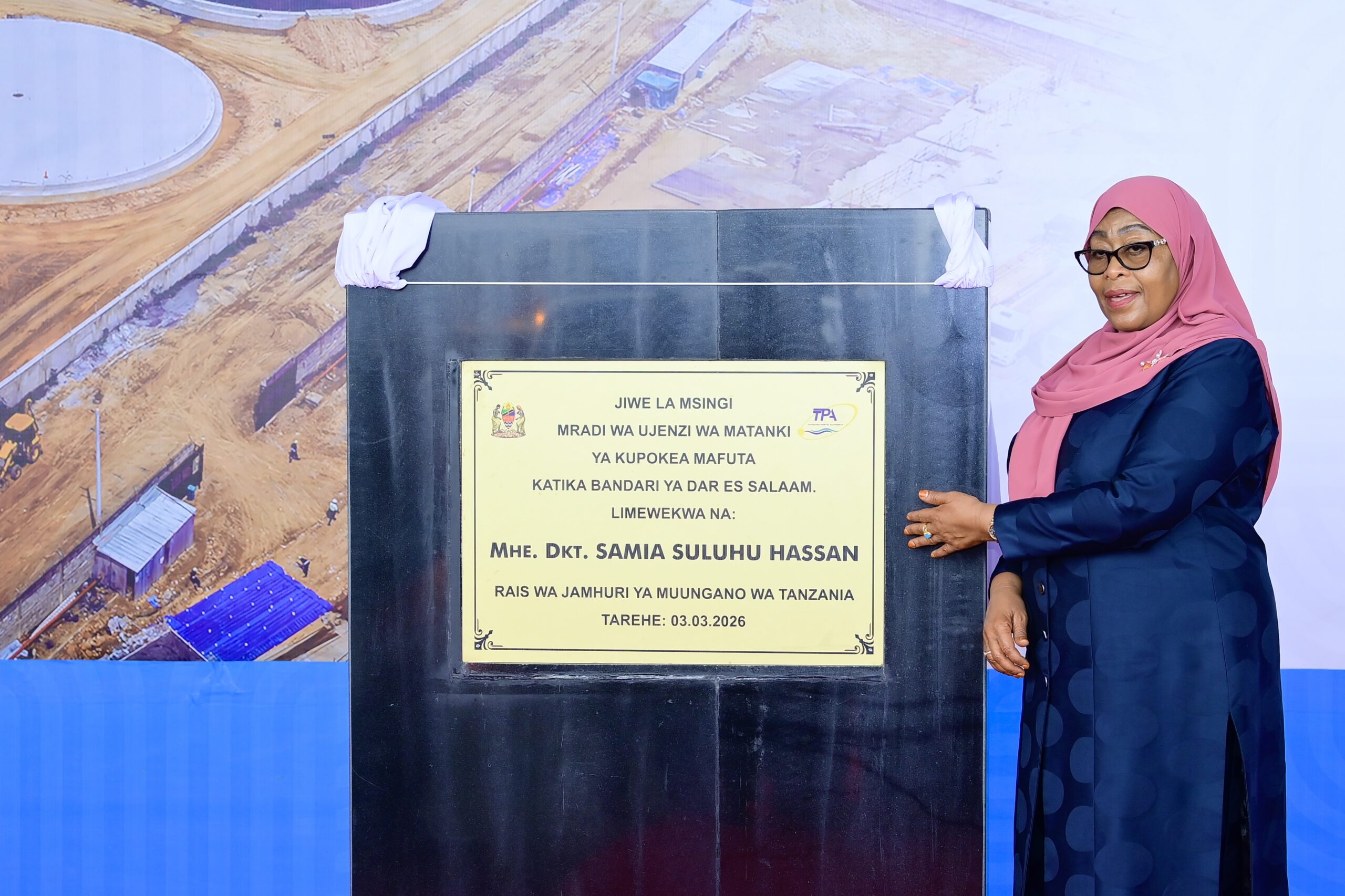
President Samia Suluhu Hassan on Tuesday directed the Ministry of Energy and other authorities to strengthen Tanzania’s strategic fuel reserves to protect the country from shortages and price spikes linked to global disruptions, including the ongoing US–Israeli invasion of Iran. Speaking during the foundation-stone ceremony for new petroleum storage tanks at the Port of Dar es Salaam, she said Tanzania must build resilience against international oil market shocks and ensure a stable energy supply for its citizens.
The Sh 701.8 billion project will expand the National Strategic Petroleum Reserve by 378,000 cubic metres—including 162,000 cubic metres of diesel, 135,000 cubic metres of petrol and 81,000 cubic metres of Jet A-1 fuel. Phase one includes construction of 15 storage tanks, site preparation, perimeter fencing and installation of 1,087 foundation piles and pile caps. As of 2 March 2026, the project had reached 41 percent completion and is scheduled to be finished by 3 February 2027, followed by a 12-month defects liability period.
President Hassan said the expansion is critical as global fuel prices have already risen 13 percent in the past week, highlighting Tanzania’s vulnerability to external market volatility. She stressed the need for proactive planning and urged global leaders to pursue dialogue to stabilize energy markets, while emphasizing that Tanzania must act decisively to safeguard its own economic stability and energy security.
According to Tanzania Ports Authority (TPA) Director General Plasduce Mbosa, the project will transform the country’s energy logistics and port operations. The construction contract, worth Sh678.6 billion including VAT, was awarded to a joint venture between China Railway Major Bridge Engineering Group Co Ltd and WUHAN Engineering Co. Ltd, while supervision services are valued at Sh23.2 billion.
Once completed, the facility will double oil handling capacity at the Port of Dar es Salaam from six million to 12 million metric tons annually and eliminate daily demurrage charges of about $25,000, costs that have often been passed on to consumers. The project has also generated 325 jobs, with 279 positions filled by Tanzanians, while local companies are supplying materials and services, and young professionals are gaining technical skills.
President Hassan said the project supports Tanzania’s broader strategy of becoming a regional trade and energy hub. She noted that improvements in port infrastructure and private sector participation have boosted efficiency and helped increase customs revenue from Sh7.3 trillion in 2020 to Sh12.3 trillion in the 2024–2025 fiscal year. Transport minister Makame Mbarawa added that investments in dry ports such as Kwala, improved rail services and partnerships with operators including DP World and TEATGL are strengthening cargo movement and reducing congestion across the country’s transport network.